“Flip sides of the same mountain”
The Brass Verdict“Flip sides of the same mountain” is Mickey Haller’s compact image for a relationship marked by kinship and separation. Spoken between Haller and Harry Bosch as they stand together at a railing and look out over the city, it describes two perspectives that belong to one landscape without being the same view. When Haller later repeats the phrase before telling Bosch that he resembles their father, the image acquires a more intimate meaning: the men share a family connection, yet Haller imagines them continuing on opposite sides of it.
First Use: A Shared Landscape, Separate Views
Haller introduces the image while explaining that the view from his own place is like the one before them, “Only it’s on the other side.” He then calls them “flip sides of the same mountain.” The wording turns a difference of position into a form of likeness. Neither man is described as occupying the other’s vantage point; their connection consists precisely in facing the same landscape from different sides.
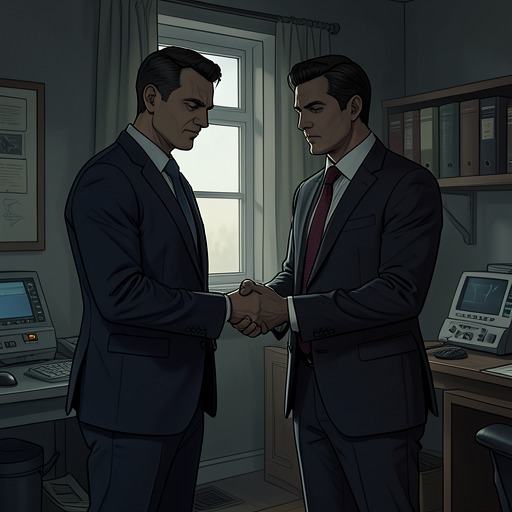
The setting gives the metaphor its physical shape. Bosch turns to the railing and leans his elbows on it; Haller changes direction and does the same beside him. Their parallel gestures create a brief visual correspondence before Haller describes their relationship in terms of opposing views. Bosch looks from the city to Haller, and answers, “Something like that.” The qualification accepts the comparison without making it a complete account of their closeness. The exchange is mutual, but restrained: Haller offers the figure, while Bosch’s reply leaves room for difference.
The Phrase Returns with a Family Revelation
The phrase returns when Haller decides to tell Bosch that he looks like their father. Before delivering the observation, Haller again invokes “Flip sides of the same mountain,” linking the earlier image of two views to the newly disclosed resemblance. Its repetition changes its emphasis: what first described parallel positions now introduces a family likeness Haller says he had failed to recognize until recently.
Haller explains that he technically put the resemblance together the previous night, while looking through old photographs and scrapbooks with his daughter. Images of his father kept bringing Bosch to mind; once Haller saw the resemblance, it seemed obvious. He also admits that he may have known it on some level for a long time. The discovery therefore has two stages: a recognition precipitated by looking at photographs, and a retrospective sense that the connection had been present, but unseen.
Bosch does not immediately answer the disclosure. He stares at Haller, nods once, and turns back to the railing to look at the city. He then asks when Haller made the connection. That question brings the conversation from the metaphor to the evidence behind it: old family photographs, memories, and the likeness Haller has only now named. The phrase does not replace the revelation; it gives Haller a cautious way to approach it.
Kinship Without Easy Reconciliation
Haller’s account of his father complicates the image rather than resolving it. Much of what he knows, he says, comes from books that record his father’s many cases and relationships with women. Alongside those accounts are a few private memories, including entering the home office his father established after becoming ill and seeing a framed print of The Garden of Earthly Delights. Haller recalls that, as a child, he thought the print was a real painting. The memory places his recognition of Bosch within a fragmentary inheritance: public records on one side, a child’s personal recollections on the other.
In that context, the mountain image can hold both resemblance and distance. Haller identifies Bosch with their father, but he does not claim that the two men share the same experience of that father, or that recognition erases their differences. The phrase’s reciprocal structure matters: each has a side, and neither is simply the other. Bosch’s brief answer to the first comparison and his silence after the family revelation keep the exchange from becoming a neat declaration of brotherly accord.
The Parting Echo
After Bosch leaves, Haller remains on the deck, watching the light move across the city. He thinks he may never see Bosch again and imagines each man having his own side of the mountain, with nothing more between them. The image has shifted from an observation made in Bosch’s presence to Haller’s private account of a possible separation. Its earlier suggestion of shared terrain remains, but Haller now fears that connection will not bring the men together.
That ending gives the phrase its unresolved force. The men have stood side by side at the railing, mirrored one another’s posture, and spoken about a resemblance to their father; nevertheless, Bosch walks away and Haller stays behind. The mountain does not promise reunion, just as the shared view does not make their perspectives identical. The phrase holds the two facts together—family connection and emotional distance—without deciding which will prevail. Its return is therefore both a recognition and a parting image: a way to name what binds Haller and Bosch, and what may still keep them apart.